Civitavecchia (for Rome) cruise port, Italy
Rome's port since Trajan built it in 106, and his harbour walls are still under the modern quays. The town was flattened in 1943, so what stands is postwar, apart from the fort on the waterfront that Bramante began and Michelangelo is said to have finished.
Worth knowing. About a thousand cruise ships a year call here and almost everybody aboard leaves at once for Rome. Civitavecchia is a town most of its visitors see through a coach window.
What to do in Civitavecchia (for Rome) for free
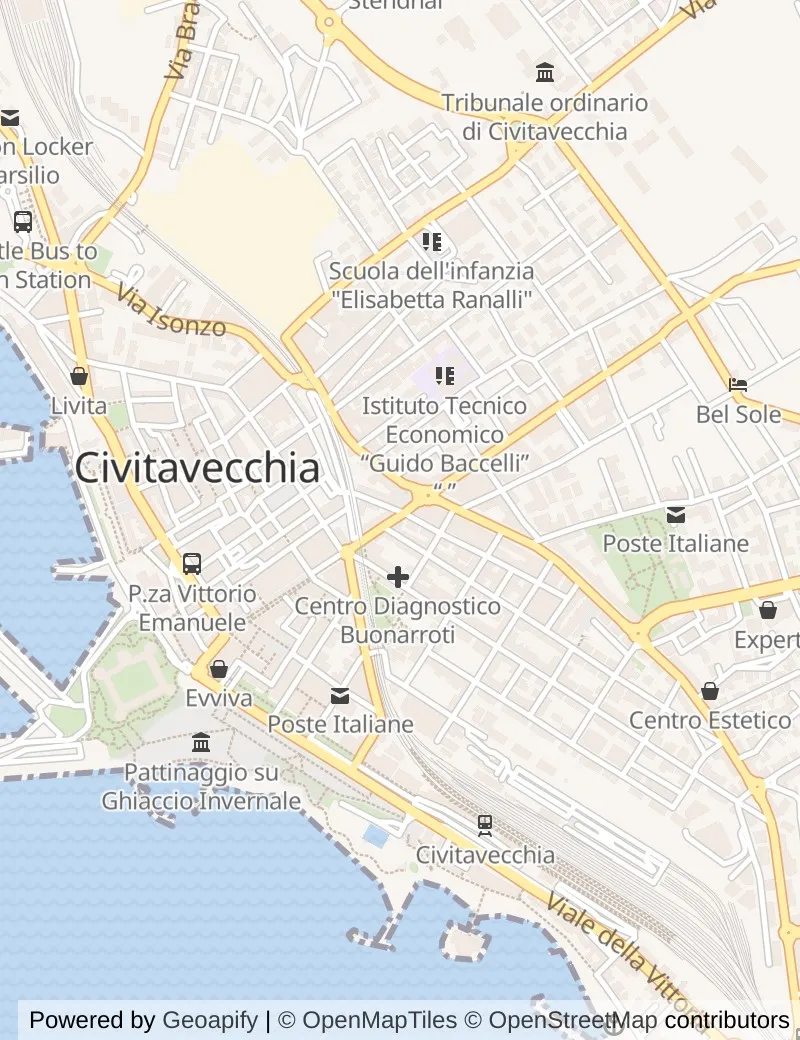
The quays are a long walk from the gate and closed to people on foot, so the port runs a free bus to Largo della Pace and that's where a day here starts. From there the old town and the Michelangelo fort are five minutes, and the town beach is ten. Almost nobody does this, which is rather the appeal of it.
What costs money
The ship's own excursions usually cost more than booking the same trip yourself. Two things come with the price. The ship waits for its own excursions and doesn't wait for you. And if the port is missed, P&O refunds its own without you asking. A trip you booked yourself is a claim on your travel insurance, so check what your policy covers. The ship sells its own trips to all of these, and the desk is open on board if you'd rather do it that way.
Rome on the train. The station is fifteen minutes from the port gate and it's about an hour and a quarter each way. It's much the cheapest way to Rome and it's also the way where nobody waits for you.
Rome with the ship. A coach each way with a guide at the other end. What you are paying for is that the ship waits for its own, which on a day this long is worth thinking about.
How long you get ashore in Civitavecchia (for Rome)
The published times give you about 13 hours alongside, depending on the sailing. Take off the time it takes a few thousand people to get off, and the time you need to be back on board before the ship leaves, and that is your day. P&O give the real hours the day before, and the all-aboard time is earlier than the departure time.
Money and language in Italy
Euro (EUR, €). Cards are normal now, and a small bar or a market stall may still prefer coins. Everything on board is charged in sterling, so this only matters ashore.
English is common where the ships call and thinner a street inland.
| English | Italian | Say it |
|---|---|---|
| Hello | Buongiorno | bwon-JOR-noh |
| Goodbye | Arrivederci | ah-ree-veh-DAIR-chee |
| How much? | Quanto costa? | KWAN-toh KOSS-tah |
| Thank you | Grazie | GRAT-see-eh |
| Please | Per favore | pair fa-VOR-eh |
Which ship calls at Civitavecchia (for Rome), and when
Every call here on sailings leaving between May 2027 and September 2027, with the hours ashore P&O published. These times are a guide, not a promise: the captain gives the real ones the day before.
| Ship | Sails | Day | Ashore |
|---|---|---|---|
| Arvia | 9 May 2027, 14 nights | Day 9 | 07:00 to 20:00 |
| Arvia | 6 June 2027, 14 nights | Day 9 | 07:00 to 20:00 |
| Arvia | 4 July 2027, 14 nights | Day 9 | 07:00 to 20:00 |
| Arvia | 15 August 2027, 14 nights | Day 9 | 07:00 to 20:00 |
| Arvia | 12 September 2027, 14 nights | Day 9 | 07:00 to 20:00 |
The other stops on these cruises
Every one of these is on at least one of the sailings that calls at Civitavecchia (for Rome).
- AlicanteSanta Barbara castle stands on the bare rock of Benacantil straight above the town, held in turn by Carthaginians, Romans and Moors because whoever had the rock had the harbour.
- BarcelonaThe Gothic Quarter is built on the Roman town of Barcino, and the Sagrada Familia has been under construction since 1882: Gaudi knew he wouldn't see it finished and said his client was in no hurry.
- Cadiz (tours to Seville)Probably the oldest continuously lived-in city in western Europe: the Phoenicians founded Gadir here around 1100 BC.
- La Seyne-sur-Mer (for Toulon)A shipbuilding town across the water from Toulon, France's main Mediterranean naval base.
- La Spezia (tours to Florence /Pisa)A naval city at the head of a gulf, and the reason ships call is what sits either side of it: the Cinque Terre villages up the coast, Pisa and Florence inland.
- MalagaPicasso was born here in 1881, in a flat on the Plaza de la Merced, and there's a museum of his work a few streets away.
Free, and it works with no internet. Give it the dates you sail and it works out your own stops. One button in Stops then saves the street map for each one. It shows you round the ship too.
All the ports written up so far, the things to do before you sail, or the ship pages for Iona and Arvia.